Why I Do This
Jennifer O’Keefe, Founder - Ignite & Elevate, LLC
I didn't set out to build a consulting firm. I set out to build something that didn't exist in my own life when I needed it most — a place where systems work, people feel supported, and nobody falls through the cracks because nobody thought to look.
That sounds abstract until you know where it comes from.
Where it starts
I grew up in an unstable environment.
My parents were eighteen and nineteen years old when they had twins. They got married for us, and separated almost immediately after. What followed wasn't a conventional back-and-forth between two stable homes — it was two young people who were themselves untethered, moving between apartments, staying with others, trying to figure out lives they hadn't planned for. There was love in there, somewhere. But stability wasn't something either of them could give us, for different reasons and in different ways.
My father worked harder than almost anyone I've known — he once went 10+ years without missing a single day of work. I saw his dedication. I knew he loved us. But circumstances he couldn't fully control made it impossible for our home to be what it should have been, and as my sister and I got older, things became genuinely difficult in ways that shaped everything that followed.
My mother struggled with addiction and was rarely present in any consistent way. I spent stretches of high school effectively on my own — in an apartment that was technically under her name, with no heat, no electricity, and no reliable way to get inside. I made adult decisions entirely by myself because there was no one else to make them.
The way things changed was not gradual. A situation arose at my father’s house — the kind that couldn't be ignored — and a school counselor called my aunt and my grandmother. We moved out that day.
My aunt took us in. She already had a house full of people — at one point fifteen of us in a Cape house — and she made every single one of us feel like the most important person in the room. She is the core of our family. Food, laughter, love, and a door that was always open. She gave us stability when nothing else did. She gave us a home.
Another aunt was a different kind of force entirely. Smart, independent, confident in a way that felt almost revolutionary to a kid who had never seen a woman own a room like that. She had fierce purple hair, and she wore it like a declaration. She believed in me with an intensity I didn't always understand, and she guided me until the day she left this earth. She once told me — almost offhandedly, like it was obvious — "you don't realize how amazing you are at connecting things and solving problems."
I have been trying to live up to that observation ever since.
Those years taught me something that no classroom could. When you grow up making adult decisions on your own — weighing risk, reading people, figuring out what is true and what isn't — you develop instincts that stay with you forever. I learned to see problems clearly and early. I learned that small things left unaddressed become big things. I learned that systems either work or they don't, and that the people caught inside a broken one rarely have the power to fix it from where they're standing.
I stayed in school through all of it. Stayed in sports. I was at the top of my class in high school and college — not because life was easy, but because performing well was one of the few things entirely within my control, and I held onto it.
The promise
My sister and I made each other a promise somewhere in those years. We would never repeat what we grew up in. We would build lives defined by stability, honesty, and doing the right thing — even when it was hard. Especially when it was hard.
That promise became the foundation of everything I have built since.
Integrity isn't a value I selected from a list. It's something I constructed from scratch, in circumstances that could have justified the opposite. I have seen what happens when people choose self-preservation over honesty — when corners get cut, when the truth gets managed rather than told, when transparency gets sacrificed for convenience. I have seen the damage it does. To organizations, to families, to the people on the receiving end of it.
I chose a different way. I still choose it. Because the truth matters. Transparency matters. Doing the right thing when no one is watching — that matters most of all.
What the work taught me
I spent nearly two decades inside healthcare operations — payers, TPAs, providers, health technology. Claims. Workflow. Appeals. Intake. The machinery that sits between a patient and the care they need.
I loved the work. I was good at it. And I cared about it in a way that went beyond professional interest — because I understood, at least abstractly, what was at stake when the machinery broke down.
Then I stopped understanding it abstractly.
When I became the patient
A few years into my career, I started losing my vision. Gradually, then suddenly. My eye doctor sent me to the emergency room immediately. The words "brain tumor" and "aneurysm" entered my life on the same day.
What followed was more than a year of the healthcare system at its most human — which is to say, at its most imperfect.
I waited months for appointments, only to have them cancelled when I arrived. I sat in waiting rooms for hours. I encountered providers who were dismissive to someone sitting there not knowing whether she had something that would kill her. I got two completely opposite recommendations from two different doctors — one said watch and wait, the other wanted to open my skull. I didn't know who to trust or what to do.
It was a personal connection — a nurse practitioner at MGH who knew someone in my life — who changed everything. A phone call. An introduction. Suddenly I was sitting across from Dr. William Curry, one of the world's leading neurosurgical oncologists and now Chief Medical Officer of Massachusetts General Hospital and Mass General Physicians Organization. For the first time, someone was explaining what was actually happening in my head — clearly, honestly, without hedging.
The diagnosis was narrowed to one of two cancers. Dr. Curry was direct: one was highly aggressive with a high mortality rate. The other was serious but treatable. To determine which one, they needed a piece of it — a surgery performed together by Dr. Curry and Dr. Eric Holbrook, Chief of Rhinology at Massachusetts Eye and Ear and Associate Professor at Harvard Medical School. Dr. Holbrook would navigate through the nose. Dr. Curry would handle the brain. Together.
The surgery was scheduled. My then-husband — my rock through all of this, the steady and solid presence who held everything together when I couldn't — was there. We had a two-year-old at home. The weight of that was always present.
The morning of the surgery, they stopped before they started. I had a sinus infection. They couldn't allow infection to reach my brain. The week before, I had gone to my primary care doctor feeling unwell, certain something was wrong. She had declined to treat it. And so the surgery that had been months in the making — that I had mentally prepared for, that my family had rearranged their lives around — was cancelled on the table.
Rescheduled. More waiting. More months of not knowing.
When the surgery finally happened, the biopsy came back. Chondrosarcoma — a rare bone cancer at the skull base, growing into the brain stem, pressing inward in a way that mimicked a brain tumor. It is so rare that most oncologists have never seen it. Stage 3. And it was the treatable kind.
The treatment: proton beam therapy at MGH — one of the finest facilities in the world for this work. Under the care of Dr. Norbert Liebsch, a radiation oncologist of international renown who had published extensively and whose patients came from around the world specifically to be treated by him. If Dr. Curry was the one who found the path forward, Dr. Liebsch was the one who walked it with you. Thorough beyond measure. Patient with every question. Genuinely hopeful — not as a performance, but as a disposition. And funny, in the way that the best doctors sometimes are — the kind of humor that makes you feel like a person in a room rather than a case on a table. He is retired now, but his impact on the people he treated is not.
Completing the team was Dr. Karen Miller — Neuroendocrinologist at MGH and Professor of Medicine at Harvard — who managed everything the tumor and treatment were doing to my body's systems. The part of the care that doesn't end when treatment does.
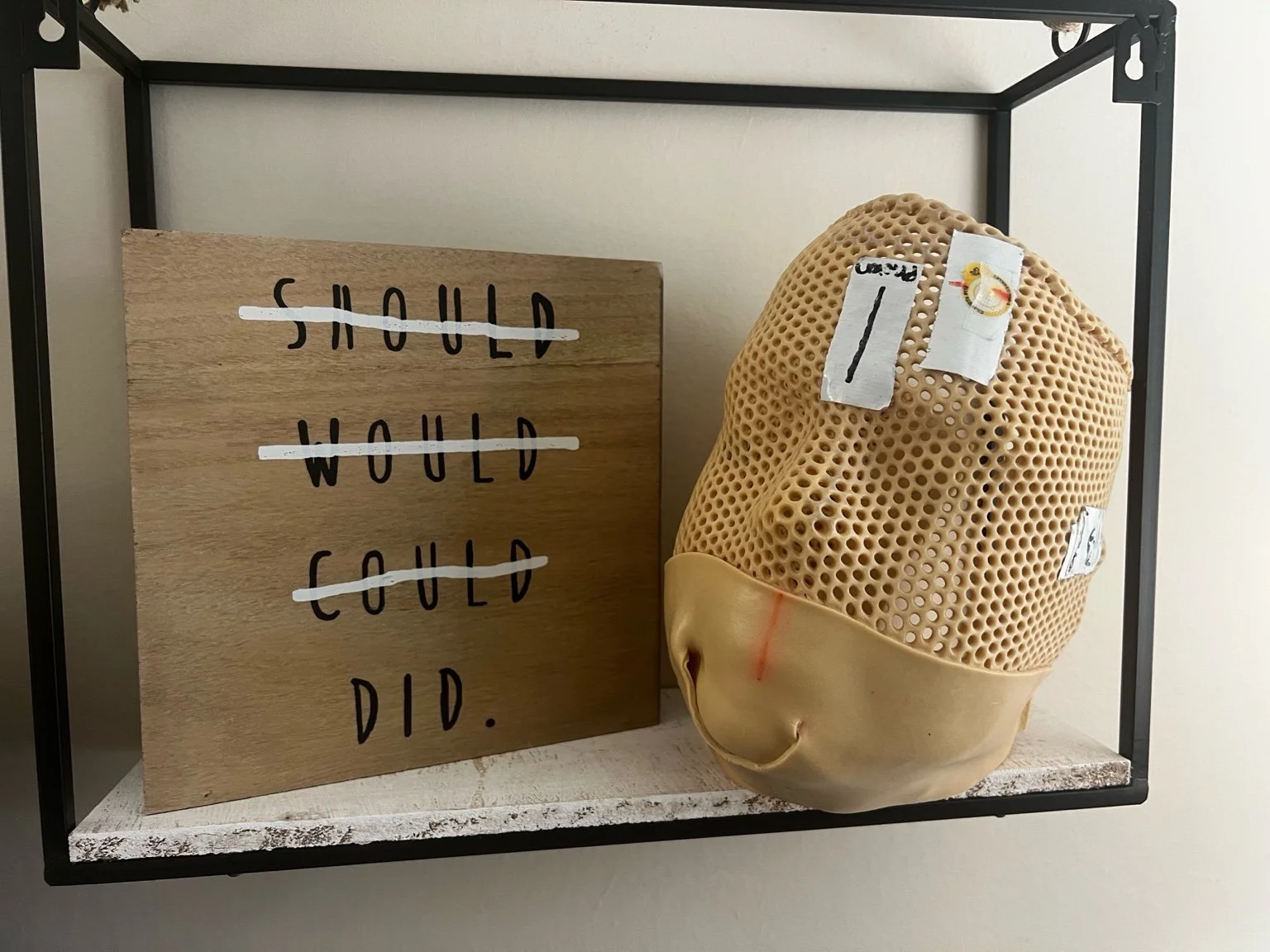
Forty days. Every day. A custom-fitted mask, molded precisely to my face, secured to the table so that the beam hit exactly the same place every single time. I kept that mask. It sits on a shelf in my home next to a small wooden sign that says: Should. Would. Could. Did.
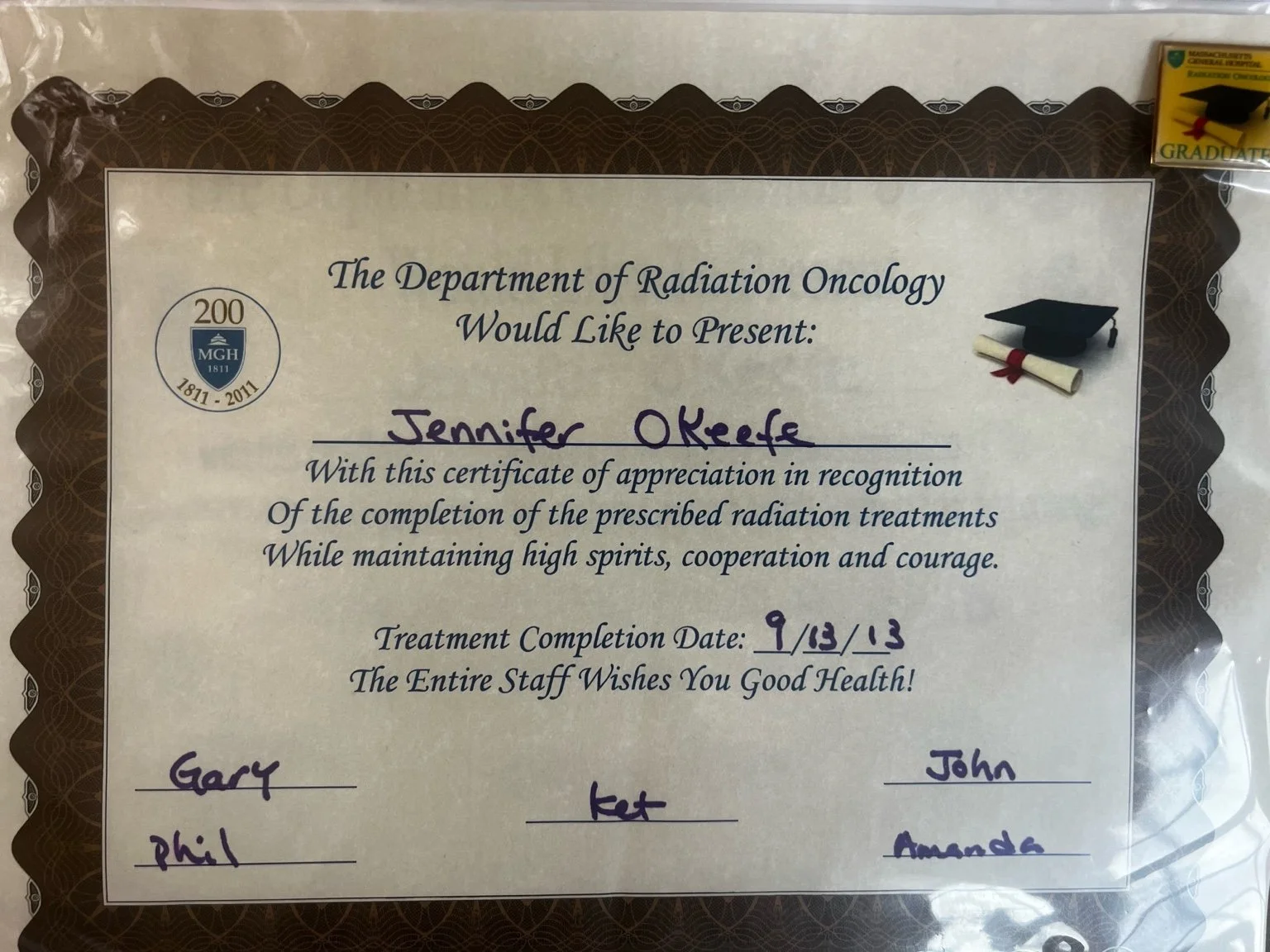
On September 13, 2013, I completed my last treatment. The Department of Radiation Oncology gave me a certificate — signed by the nurses and staff who had shown up every single day — recognizing the completion of treatment "while maintaining high spirits, cooperation, and courage."
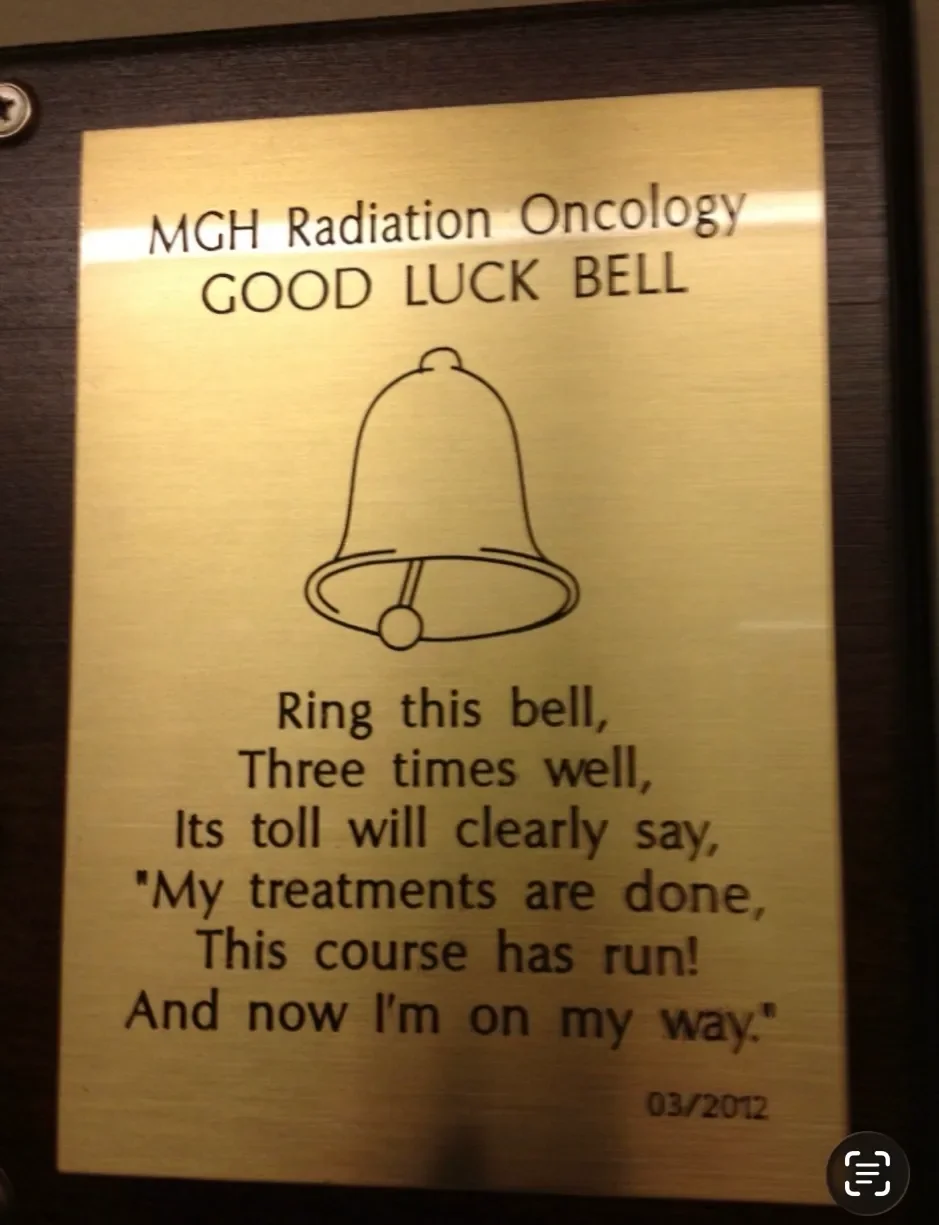
And then I rang the bell.
Ring this bell, three times well, Its toll will clearly say, "My treatments are done, this course has run, And now I'm on my way."
I still carry the aneurysm. The risk of intervention outweighs leaving it alone. So it stays. The MRIs continue. The monitoring doesn't stop. The story isn't over — it's just a different chapter.
I did not go through any of this alone. Not because of who you might expect — my mother and father were both alive during this time, and neither one called. Neither asked. Neither came.
But someone from a previous job drove me to treatment once a week, every week, for 8 weeks — entirely out of her own generosity, with no obligation to do so. And other family and friends showed up with rides, meals, and support. My twin was there. My then-husband was a constant. People who chose to show up, showed up.
We have since gone our separate ways, and he remains one of my closest friends. I will always be grateful for who he was during that time. Some relationships change form without losing their meaning. Ours is one of those.
The people who didn't show up taught me something too. They showed me, more clearly than anything else could, that community is not about proximity or obligation or shared history. It is a choice. It is showing up when you don't have to. It is driving someone to a proton beam chamber on a Tuesday because they need you to.
That is the community I am building. That is the standard I hold myself to. That is why it matters so much.
Through all of it — the waiting, the cancelled surgery, the prior authorization that had to be approved before treatment could begin, the biopsy rescheduled because one provider didn't act on what I told her — I kept thinking about the work I did every day.
Every one of those moments was a transaction in a system I had spent my career building and improving. Every delay had a process failure behind it. Every miscommunication had a workflow gap. Every moment of feeling like a number rather than a person had a design problem at its root.
I wasn't angry. I was more convinced than ever.
This work matters. Not because it's intellectually interesting — though it is. Not because the operational challenges are genuinely complex — though they are. But because on the other side of every claims transaction, every appeals decision, every letter, every routing rule — there is a person. Waiting. Hoping the system works the way it's supposed to.
I was that person. I know exactly what it feels like when it doesn't. And I know what it feels like when it does — when the right team is in place, when the process works, when someone takes the time to answer every question and makes you feel like you are in the best hands in the world.
Both experiences shaped me. Both drive me.
Who I work with — and why it matters
I am selective about the organizations I partner with. Not out of arrogance — but because this work only means something when the commitment to change is real.
I want to work with organizations that know why they exist. That are honest about the gap between where they are and where they should be. That want to do things right — not just faster. That are willing to look clearly at what is broken and actually fix it, rather than paper over it with a report that sits on a shelf.
Healthcare operations affects real people. Every transaction, every process, every decision has someone on the other side of it. I have been that person. I take that seriously. I need my clients to take it seriously too.
If that is you — if you are building something that genuinely matters and you want the operational foundation to match the mission — I would be glad to talk.
What Ignite & Elevate is really about
The name was never accidental. I wanted something that captured a feeling — the idea that a single moment, a single connection, a single person believing in you could ignite something that elevates everything that follows. Your mood. Your confidence. Your sense of what is possible.
From passion to possibility. That is the whole idea.
The consulting practice is the foundation. But Ignite & Elevate was always meant to be more.
The long-term vision is a space. Physical. Real. A place where people arrive feeling ordinary and leave feeling like something in them has been lit.
Open mic nights and local bands. Painting and pottery. Cornhole and shuffleboard. Fitness and business. A bar and a juice bar because I want everyone to feel welcome. A light menu. Smiling faces at the door. The kind of place where you come alone and leave belonging somewhere.
And underneath all of it — mentorship. Finding the young women and men who grew up the way I did, who have everything it takes but no one telling them so, and connecting them with people who will change the trajectory of their lives. The way my aunt changed mine. The way a single offhand comment about connecting problems planted something in me that is still growing.
I grew up watching athletes cross the finish line at the Boston Marathon and crying — genuinely crying — because I could feel how hard they had worked and how proud they must have been. I grew up admiring anyone who built something of their own, because I knew what it cost to believe in yourself enough to try.
This is me trying.
I am building the thing I needed. For the organizations that deserve better operations. For the patients who deserve a system that works. For the young people who need someone firmly in their corner. For everyone who has ever sat in a waiting room, or a hard season of life, hoping someone sees them.
My aunt once told me I didn't realize how amazing I was at connecting things and solving problems.
I believed her. Eventually.
I hope you find someone who believes in you like that. And if you haven't yet — that is exactly what I am here to build.
Every transaction matters. Every person on the other side of one does too.
Ignite something.
Elevate everything.